
Trucking runs on tight margins and tighter schedules, yet most carriers still juggle five tools to move one load. AxleFlow exists to close that gap, giving small and growing fleets the same operational muscle as the big players, without the overhead.
AxleFlow started with conversations, not code. We talked to dispatchers working out of notebooks, owner-operators invoicing from their phones at midnight, and fleet managers piecing together compliance records from three different inboxes.
What we heard was consistent: the tools built for trucking were either too basic to scale with, or too complex to justify the cost. So we built the platform we kept hearing carriers wish existed.
WHY WE’RE HERE
A five-truck fleet and a fifty-truck fleet face the same problems: keeping loads moving, keeping drivers paid, and keeping paperwork off their desk. Our job is to make sure the size of your operation never dictates the size of your admin burden.
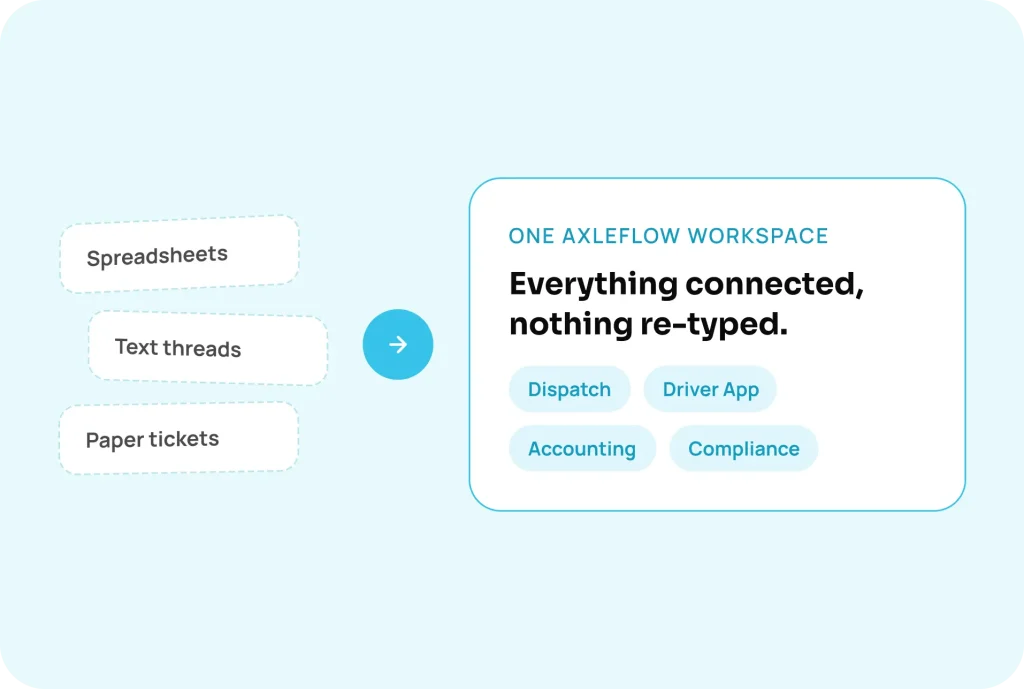
Most delays and errors in trucking don’t happen on the road, they happen in the handoff between systems. We designed AxleFlow around eliminating those handoffs entirely.
A load, a driver update, a document, it only needs to be entered once, from wherever it originates.
Rates, mileage, and accessorials get verified in the background, before they become a billing problem.
Once information is confirmed, the next step (an invoice, a settlement, a status update) generates without anyone chasing it.
A completed load means everything tied to it, paperwork included, is actually done.
We don’t build features for the sake of a longer list. Every part of AxleFlow ties back to time or money a carrier can measure.
Assign loads, track routes, and manage exceptions from one screen, without switching between five apps to do it.
Once a load is delivered, invoicing and driver pay move forward automatically, cutting the lag between delivery and getting paid.
Know your cost-per-mile and profit-per-mile on every lane before you commit to a rate, not after.
Renewals, inspections, and safety records are tracked proactively, so nothing becomes a fire drill.
Simple check-ins, document uploads, and delivery confirmations, all handled from a phone, not a clipboard.
If a workflow doesn’t make sense from behind the wheel, it doesn’t ship.
A connected platform will always outperform a stack of disconnected tools, no matter how good each tool is on its own.
Status updates are nice. Real margin data is what actually changes decisions.
Compliance and maintenance issues are cheapest to fix early, so that’s when we surface them.
JOIN THE TEAM
Our team includes former dispatchers, fleet operators, and logistics engineers. We build for the industry because we’ve worked in it, not around it.
THE ROAD AHEAD
No more piecing together five tools to run one operation. Just one platform, built around how freight really moves.
One Flow: Software and Support Together
No more piecing together five tools to run one operation. Just one platform, built around how freight really moves.